
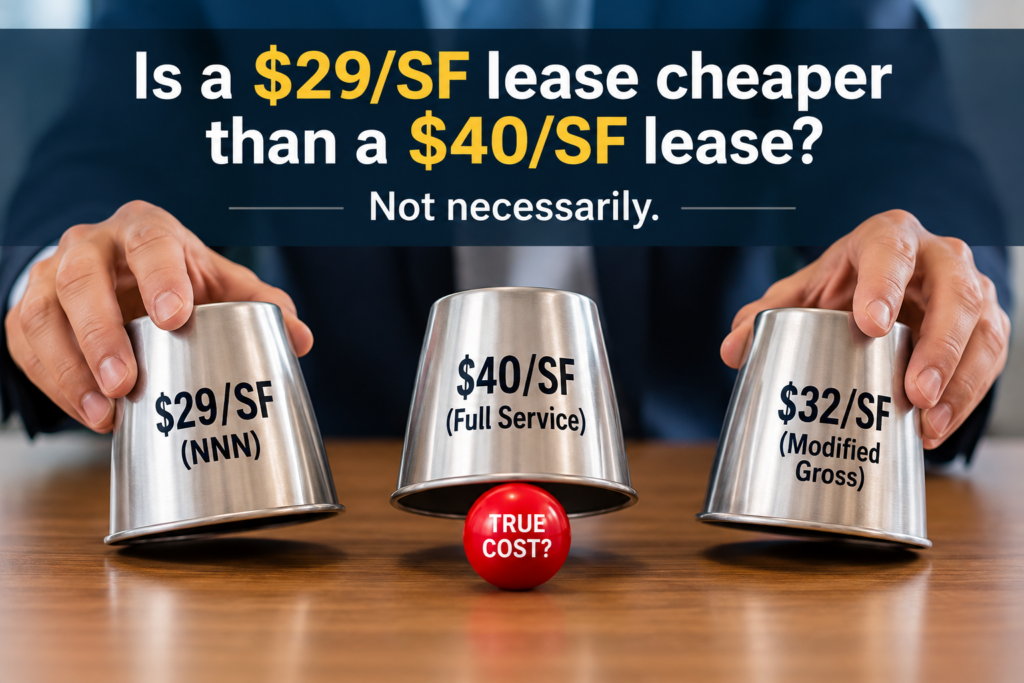
Rental rate shell game
You’ve probably seen a shell game. I know I have.
Someone puts a ball under one of three shells, moves them around quickly, and challenges you to keep track of where the ball ends up. I lost an embarrassing amount of money to a guy who hustled me with a shell game using playing cards when I was in my 20’s. Fortunately, at that time, $20 was significant and embarrassing.
Commercial real estate has its own version of the shell game. Instead of a ball and shells, however, operating expenses are moved around under different types of rental rates.
If you don’t keep track of them, the space that looks cheapest may actually cost you the most.
There Are Really Three Costs All Tenants Pay
Regardless of how a landlord quotes the rental rate and whether tenants realize it or not, all tenants pay three categories of occupancy costs:
- Base rent – What you pay for the right to occupy the space.
- Common operating expenses – Property taxes, insurance, landscaping, common-area utilities, management fees, repairs and other expenses necessary to operate the property.
- Suite-specific expenses – Costs associated specifically with your premises, which might include electricity, janitorial, HVAC maintenance, plumbing repairs or other services.
The tricky part is that these expenses may be paid by the landlord and billed under a single rental rate or could be billed separately all through the landlord or through multiple providers.
Full Service, Triple Net, Industrial Gross…What Does It All Mean?
Commercial leases use terms like Full Service, Full Service Plus Electric, Industrial Gross, Modified Gross, Triple Net and Absolute Net.
Those terms sound important—and they are—but, ultimately, they describe one thing:
Which expenses are included in the quoted rental rate and which ones will you pay separately?
A Full Service lease generally includes most operating expenses in the rental rate, although tenants typically pay increases in expenses above a base year.
A Triple Net—or NNN—lease goes in the other direction. The tenant pays base rent plus its share of most property operating expenses. Those expenses could be paid to the landlord who arranges for all the services in the building or you could arrange for some or all of the services (utilities, janitorial, etc.) and pay the vendor directly.
And then there’s “Modified Gross,” which can mean almost anything. When I hear that term, my next question is always:
Modified how? What does the tenant pay in addition to the rent?
The name of the rental structure matters far less than what’s actually included in it.
Don’t Compare Rental Rates. Compare Total Occupancy Costs.
Suppose you’re considering two buildings.
Building A quotes $40.00 per square foot.
Building B quotes $29.00 per square foot.
Easy decision, right?
Not necessarily.
If Building B is Triple Net and operating expenses are another $12.00 per square foot, your actual cost is $41.00.
Suddenly the “$29 building” costs more than the “$40 building.”
That’s why tenants should never compare buildings based solely on rental rates. Instead, identify every expense you’re responsible for under each lease and calculate the total occupancy cost.
Make the Landlord Turn Over Every Shell
Before signing a lease—or deciding which building offers the best deal—ask exactly what you’ll be responsible for paying.
Don’t stop when the leasing agent tells you the rent and estimated operating expenses.
Ask: “What else will we pay in addition to these amounts?”
Electricity? Water? Trash? Janitorial? HVAC maintenance? After-hours HVAC? Management fees? Repairs?
Turn over every shell.
Because once you know what’s underneath all of them, the shell game stops working.
Bob Gibbons is a Real Estate Advisor & Tenant Advocate (also known as a tenant rep) with REATA Commercial Realty, Inc. which is a tenant advisory firm based in Plano, Texas. Bob serves companies in the Dallas Fort Worth area and throughout the US which occupy office and warehouse properties which they lease or buy.