
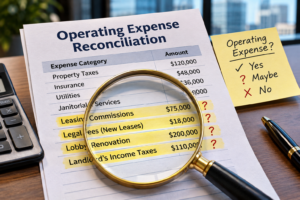
 Your landlord sends you the annual operating expense reconciliation.
You owe more money.
So you pay it.
But should you?
Most commercial tenants assume that if an expense appears on the landlord’s statement, it must be legitimate.
Here’s a little secret from a recovering landlord: Just because an expense is legitimate doesn’t mean you should be paying for it.
There’s a big difference between an expense the landlord incurs and an expense the landlord should be allowed to pass along to tenants.
And that difference can cost you a lot of money.
Some Costs Should Belong to the Landlord
Operating expenses generally cover the costs of operating, maintaining, repairing, and managing a property.
Sounds reasonable.
But landlords incur plenty of expenses that have little or nothing to do with operating the building for the benefit of its tenants.
Consider a few examples.
Leasing commissions and legal fees. Should existing tenants pay the landlord’s brokerage commissions or legal fees associated with leasing space to new tenants? Of course not, and, fortunately, most leases exclude these costs.
Income taxes versus property taxes. Should tenants pay the landlord’s income taxes? Absolutely not. Those are the landlord’s responsibility. Property taxes, on the other hand, are commonly passed through to tenants. That’s an important distinction.
Renovations to attract new tenants. Suppose the landlord spends $2 million renovating the lobby, upgrading common areas, and creating a more impressive entrance to attract new tenants willing to pay higher rents.
Should the existing tenants foot the bill?
No chance.
The landlord may benefit from higher rental rates and an increase in the property’s value. That’s an investment in the property, not an ordinary operating expense.
Costs caused by other tenants. What if another tenant damages the building or requires unusually expensive services? Should everyone else share those costs? Generally, no. Those expenses should be charged to the responsible tenant and deducted from the pool of “common” expenses that are shared by all tenants.
Penalties and interest. If the landlord pays a bill late or incurs a fine, tenants should not pay for that mistake.
You get the idea.
The point isn’t that these expenses are illegitimate. The landlord may have perfectly good reasons for incurring them.
The question is whether they belong on your bill.
Capital Improvements Get More Complicated
Not every capital expenditure should automatically be excluded from operating expenses.
Sometimes a major improvement benefits the tenants financially.
Let’s say the landlord installs a $100,000 energy-management system that reduces the building’s operating expenses by $20,000 per year.
That’s a good thing for everyone.
The landlord has made an investment, and the tenants will benefit from lower utility costs.
In that situation, allowing the landlord to recover the cost over time through amortization makes sense.
But there should be limits.
For example, the annual amount passed through to tenants shouldn’t exceed the actual savings generated by the improvement.
And tenants shouldn’t be required to pay the entire $100,000 in the year the system is installed. The cost should be spread over the improvement’s useful life.
Now compare that to the landlord spending $2 million on a beautiful new lobby primarily to increase the property’s value and attract tenants willing to pay higher rents.
That’s a very different situation.
One investment reduces the tenants’ expenses. The other primarily improves the landlord’s investment.
Your lease should recognize the difference.
Trust, but Verify
Here’s another little secret: Landlords make mistakes.
I know. Shocking.
Sometimes expenses get charged to the wrong property. Sometimes excluded expenses slip into the reconciliation. Sometimes the landlord’s accounting department simply makes an error.
And occasionally, the landlord and tenant disagree about what the lease actually permits.
That’s why every commercial lease should include operating expense audit rights.
Your lease should give you the right to examine the landlord’s records supporting the expenses you’ve been charged.
If the audit reveals an overcharge, the landlord should reimburse you.
And if the discrepancy exceeds an agreed threshold—say 5%—the landlord should also pay the reasonable cost of the audit.
There should also be a reasonable period to review the reconciliation and request an audit.
Otherwise, you might lose your rights before you’ve had a chance to determine whether the charges are correct.
Will you ever actually conduct an audit?
Maybe not. But having the right to do so gives the landlord a little extra incentive to get the numbers right in the first place.
Funny how that works.
Don’t Forget to Put a Lid on Increases
Even if every expense the landlord passes through is legitimate, there’s another problem.
How much can those expenses increase each year?
Suppose your operating expenses are $10 per square foot. A 10% increase adds another $1 per square foot. For a company leasing 20,000 square feet, that’s an additional $20,000 per year.
And if expenses continue increasing, the impact compounds.
That’s why I typically start negotiations by requesting a 5% annual cap on increases of controllable operating expenses.
What is controllable?
Generally, expenses the landlord has some ability to manage, such as administrative costs, management fees, landscaping, janitorial services, and certain maintenance expenses.
Property taxes, insurance, and utilities are commonly excluded from these caps because the landlord has limited control over them.
A cap won’t eliminate operating expense increases, but it can help protect tenants from unexpected spikes in costs the landlord can influence.
One more detail: I prefer a noncumulative cap, meaning unused increases in one year can’t be carried forward and added to a future year’s allowable increase.
As with everything else in a commercial lease, the details matter.
Don’t Treat Operating Expenses as Boilerplate
Companies understandably spend a lot of time negotiating rental rates, tenant improvement allowances, and free rent.
Operating expense language rarely gets the same attention.
It should.
A commercial lease might run three, five, or even ten years.
Over that time, seemingly small differences in what the landlord can charge—and how quickly those charges can increase—can add up to substantial amounts of money.
And once you’ve signed the lease, it’s usually too late to renegotiate those provisions.
So by all means, negotiate the rent.
But don’t forget to negotiate the rules governing everything you’ll pay in addition to the rent.
Because sometimes the biggest surprises aren’t hiding in the rental rate.
They’re hiding in the fine print that determines what else you have to pay.